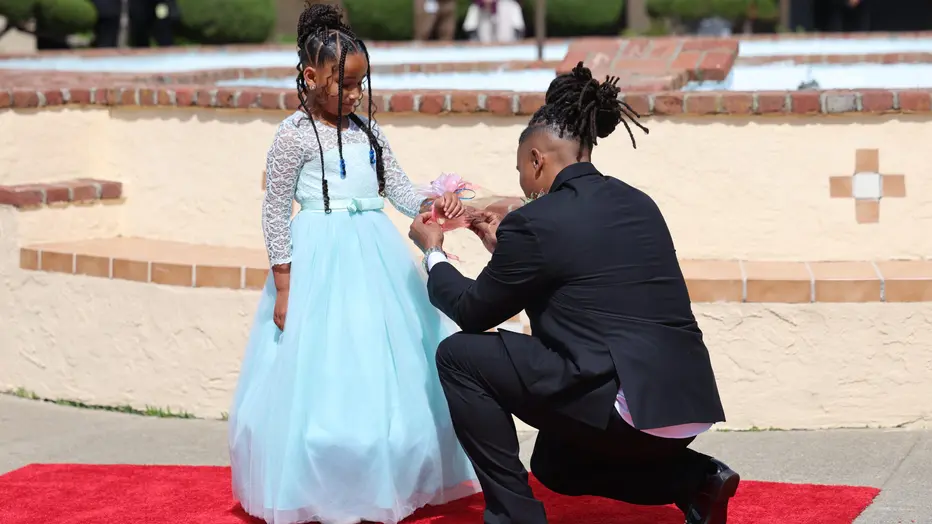
There are moments when the barriers that separate us dissolve, when healing becomes possible even in the most unlikely places, and when the power of human connection reminds us what truly matters. Such a moment unfolded at San Quentin Rehabilitation Center on April 5, 2025, during the facility’s first-ever father-daughter prom. This story illuminates the challenges families face when incarceration intersects with mortality, grief, and the fundamental human need for connection.
For many of the incarcerated participants at San Quentin’s prom, it was the first time they’d ever donned a tux, the first time they spent one-on-one, face-to-face time with their daughter, and the first dance they’d ever had with their child. For some, it was the first time they’d ever met their daughter.
This reality speaks to a form of disenfranchised grief that permeates the incarcerated community, the loss of milestones, the absence from life’s defining moments, and the ongoing separation from loved ones that creates its own form of anticipatory grief. When we consider end-of-life care within the context of incarceration, we’re not just dealing with terminal illness or aging; we’re addressing decades of accumulated loss and missed connections.
The prom was the culmination of an eight-week family communication workshop created by Tam Nguyen, an incarcerated resident who has spent 22 years at San Quentin. Nguyen’s program recognizes something critical that our justice system often overlooks: incarceration doesn’t just affect individuals, it fractures entire family systems, creating ripple effects of grief, trauma, and disconnection that can span generations.
The Intersection of Incarceration and Mortality
What makes this story particularly relevant to Pollen’s incarceration collection is how it reveals the complex ways that imprisonment compounds end-of-life challenges. Incarcerated individuals face multiple forms of mortality-related trauma:
Separation during family deaths. Many incarcerated people are unable to attend funerals, say goodbye to dying relatives, or participate in grief rituals that help families heal together.
Their own health crises behind bars. Medical care in correctional facilities is often inadequate, and family members struggle to advocate for their loved ones or be present during health emergencies.
Uncertain futures. Long sentences create a unique form of anticipatory grief for families who must navigate the possibility that their loved one may die in prison, or that they themselves may not live to see their incarcerated family member return home.
Intergenerational trauma. Children grow up visiting parents in prison, normalizing separation and often developing complicated relationships with both the justice system and their own family dynamics. These children face unique developmental challenges as they process their parent’s absence while navigating societal stigma.
Supporting Children Through Incarceration: Age-Appropriate Conversations and Coping Strategies
One of the most heartbreaking aspects of the San Quentin story is that some fathers were meeting their daughters for the first time. This reality highlights a critical gap in our support systems: how do we help children understand and cope with parental incarceration at different stages of their development?
Early childhood (ages 2-5): Young children need simple, honest explanations. “Daddy is in a place where he has to stay for a while because he broke some rules, but he still loves you very much.” At this age, maintaining routine and connection through letters, photos, and supervised calls becomes crucial. Children this young may blame themselves or fear abandonment, so consistent reassurance about their parent’s love is essential.
School age (ages 6-11): Children at this stage can understand more complex explanations but still need protection from adult details. They benefit from knowing basic facts: “Mom is in prison because she made some mistakes, and now she’s working to make better choices.” These children often face peer questions and potential stigma at school. Supporting caregivers need tools to help children navigate these social challenges while maintaining their connection to their incarcerated parent.
Adolescence (ages 12-18): Teenagers can handle more detailed conversations about justice, consequences, and systemic issues. They may feel anger, embarrassment, or conflicted loyalty. This is when programs like Nguyen’s become especially valuable. This creates structured opportunities for honest dialogue about relationships, communication, and healing. Teens need space to express complex emotions without judgment and support in understanding how their parent’s incarceration affects their own identity formation.
Young adults (18+): Adult children face unique challenges, especially if they’re now parenting their own children. They must decide how to explain their parent’s absence to the next generation while processing their own grief and potential resentment. The daughters at San Quentin’s prom, some meeting fathers for the first time as adults, represent this complex dynamic of trying to build relationships across years of separation.
Supporting coping strategies across all ages:
- Maintaining regular, predictable contact when possible
- Creating memory books and photo albums to preserve connection
- Facilitating age-appropriate visits that prioritize the child’s emotional safety
- Connecting families with support groups specifically for children of incarcerated parents
- Addressing the shame and stigma children often carry
- Helping children understand that their parent’s choices don’t define them
- Providing counseling resources that understand the unique trauma of parental incarceration
The workshop that led to San Quentin’s prom recognized something crucial. Healing requires intentional work on both sides. While incarcerated parents learned communication skills, their children also needed support processing years of separation, confusion, and often anger. The success of that evening came not just from the magical atmosphere, but from weeks of preparation that acknowledged the complexity of these relationships.
The story takes a tragic turn that underscores why these moments of connection matter so much. Steven Embrey, one of the workshop participants, danced with his 28-year-old daughter Tiara at the prom. Just weeks later on June 8, a car accident took her life. “He got the only dance he’s ever done with her,” Nguyen said.
Steven’s experience represents a devastating reality for incarcerated families: the knowledge that time is finite, opportunities are limited, and loss can happen without warning. “I’m so happy I participated in the prom and I got to see her. She was so beautiful that day. I have so many beautiful memories,” Steven told reporters.
This underscores a critical need in our end-of-life care systems: How do we support incarcerated individuals who are grieving? How do we help families process loss when one member cannot be physically present for traditional grief rituals? How do we address the complex guilt, regret, and helplessness that incarcerated parents feel when they cannot comfort their families during times of loss?
Breaking Cycles: The Rehabilitation Imperative
Nguyen’s program addresses something fundamental that connects incarceration to broader patterns of trauma and loss. He recognized that “the majority of these people that came to prison, that committed crimes, also came from a dysfunctional home,” adding that “A lot of the incarcerated people come from underserved communities, single-parent households.”
This speaks to what researchers call the “pipeline” effect. It shows how childhood trauma, family dysfunction, and community disinvestment create pathways to incarceration. But Nguyen’s approach also suggests a pathway out: “So in order for this person to become whole, I believe, that you need to help heal and rehabilitate the entire family.”
This holistic understanding is crucial for end-of-life care providers working with families affected by incarceration. We cannot address one person’s end-of-life needs without understanding the broader family system, including how incarceration has shaped relationships, communication patterns, and trust.
Sacred Moments Behind Bars
The most poignant moment came in a video that circulated on social media, showing “Tommy has spent nearly two decades inside San Quentin State Prison. For 19 years, he’s only seen his daughter in a visitation rooms. But last night, everything changed… For one sacred evening, prison walls faded away. Tommy held his daughter, not in chains, not through glass, but in his arms. They wept. She clung to him. Time stood still.”
This image challenges us to think differently about dignity, humanity, and healing within the justice system. If we can create sacred moments like this during incarceration, what does that mean for how we approach end-of-life care for incarcerated individuals? How do we honor the full humanity of people who are dying in prison while maintaining security protocols? How do we support families who are grieving someone who died behind bars?
Policy Implications and Systemic Change
The success of Nguyen’s program raises important questions about how our systems could better support families affected by incarceration:
Compassionate release policies. Should terminally ill incarcerated individuals have greater access to compassionate release to die with dignity alongside their families?
Family visitation during health crises. How can correctional facilities better accommodate family presence during medical emergencies or end-of-life situations?
Grief support services. What resources exist for incarcerated individuals who lose family members while imprisoned? How do we support children who lose an incarcerated parent?
Reentry and family reunification. How do we prepare families for the complex emotions and relationship dynamics that emerge when someone returns home after years of separation?
A Model for Healing
Autumn O’Bannon, whose father was released a month after the dance, shared: “Having my Dad home has been a breath of fresh air. Being able to spend unrestricted time with him and watching him spend quality time with my sons (his grandsons), brings me so much joy.”
This represents the kind of generational healing that becomes possible when we address incarceration not just as individual punishment, but as a family and community challenge requiring comprehensive support.
The prom at San Quentin also demonstrates how community partnerships can create transformative experiences. Hair stylists, businesses, correctional staff, and advocacy organizations all contributed to making the event possible. They showed how healing requires collective investment and creativity.
Nguyen’s vision extends beyond prison walls. “My ultimate goal is to bring it to the streets, because I do believe healthy families create healthier people, healthy individuals. And those same healthy families create safer communities.”
This prevention-focused approach recognizes that addressing incarceration requires upstream interventions. Supporting families and communities before crisis hits, providing tools for healthy communication and conflict resolution, and creating systems that prioritize healing over punishment.
For those of us working in end-of-life care, this story challenges us to consider how our services intersect with the justice system. Are we prepared to support families navigating grief while dealing with incarceration? Do we understand the unique trauma patterns that emerge from family separation? Are we advocating for policies that recognize the fundamental human need for connection? Or in our most punitive institutions?
The Dance We All Need
The fathers and daughters who danced at San Quentin remind us that healing is always possible, that connection transcends circumstances, and that the most profound moments of grace often happen in the most unexpected places. Their story is ultimately about the universal human need for love, forgiveness, and second chances.
As we continue to examine the intersections of incarceration, health, and family well-being through Pollen’s collection, this story serves as both inspiration and challenge: How do we create more opportunities for healing within our justice system? How do we support families facing the complex grief that comes with incarceration? And how do we build communities that prioritize connection and healing over separation and punishment?
Sometimes the most important dance is the one we almost didn’t have. And sometimes, the most transformative healing happens when we refuse to let walls define the limits of love.
Please follow this link to read the original story:
San Quentin’s First Prom