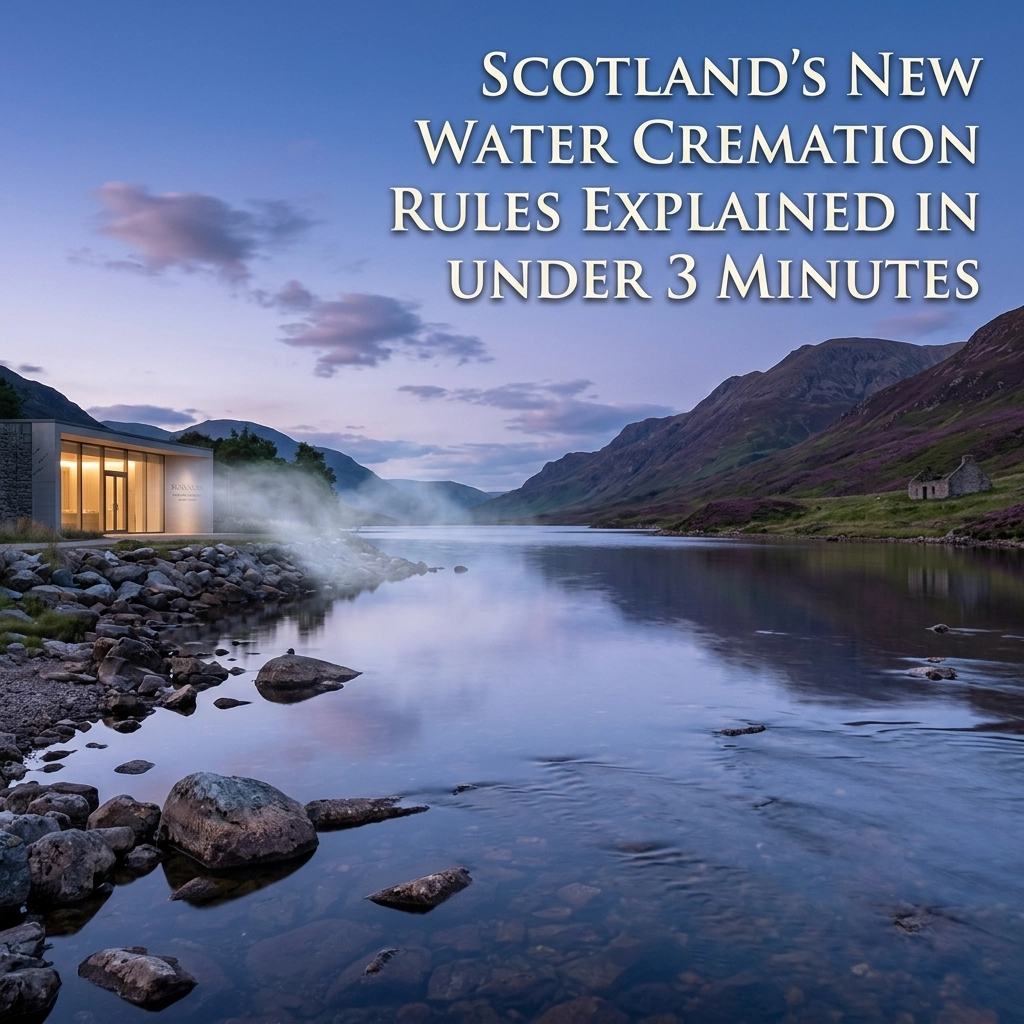
Have you ever stood on the banks of a Highland loch, feeling the spray of the water on your face and the ancient rhythm of the land beneath your boots, and thought, "This is where I belong"? Have you imagined your final journey as something more than a clinical room and a plume of smoke? What if your last act on this earth could be as gentle as a mountain stream and as clean as the Highland air?
If you’ve been looking for a way to return to the earth that feels a little more… well, natural, then the news from March 2nd, 2026, is going to feel like a breath of fresh air. Scotland has officially become the first part of the UK to greenlight water cremation, also known as Resomation. It’s a huge shift in how we think about the "final adventure," and it’s one that fits perfectly with the wild, water-carved beauty of our home.
The "3-Minute" Quick Guide
I know life is busy, so if you’re just here for the facts, here is the "boiled down" version (pun intended):
- When did it happen? March 2, 2026. Scotland is now the leader in the UK for this tech.
- What is it? It’s called Resomation (or alkaline hydrolysis). Instead of fire, it uses water and a dash of alkaline solution.
- Is it green? Absolutely. It has a 7x lower CO2 footprint than traditional flame cremation.
- What do I get back? You still receive "ashes," though they are actually pure white powdered bone. They are sterile, soft, and perfect for scattering.
- Can I scatter them with Pollen? Yes! These remains are ideal for our water-based and land-based scattering services.
Now, if you have a little more time, let’s talk about why this actually matters and how it changes the game for anyone dreaming of a final rest in the Scottish wilderness.
A Gentler Way Home
For centuries, we’ve had two main choices: the earth or the fire. But fire is aggressive. It’s loud, it’s hot, and it carries a heavy environmental price tag. Water cremation is different. It’s a quiet process that mimics the natural way the body returns to the earth, just sped up a little.
Imagine your loved one being cradled by water. The process uses a gentle flow of water and a small amount of potassium hydroxide, heated under pressure. Over a few hours, the soft tissues return to their elemental components. What remains are the bones, which are then processed into a fine, snow-white powder.
It’s a transition that feels less like an ending and more like a merging. In a land defined by its lochs, its "burns" (that’s Scottish for streams, for our friends further afield!), and its mist, choosing water feels like a poetic homecoming.

Why Scotland is Leading the Way
On March 2nd, 2026, we didn't just change a law; we embraced a future that respects our landscape. Scotland has always been a place of pioneers, from the Enlightenment thinkers to the explorers who mapped the globe. It makes sense that we are the first in the UK to adopt a funeral method that protects our "bonnie banks."
The environmental impact is the real headline here. Traditional cremation releases a significant amount of CO2 and mercury into our atmosphere. Resomation, however, uses about 80% less energy. There are no chimneys, no smoke, and no heavy emissions. When we talk about a "final adventure," we want that journey to leave the world just as beautiful as we found it. By choosing water cremation, you are ensuring that the fierce coastal winds and the ever-changing Highland light remain clear for the generations coming after you.
The Beauty of the Remains
One of the questions I get most often is, "But Michaelene, will I still have something to scatter?"
The answer is a resounding yes. In fact, the remains from water cremation are often described as being more "pure" in appearance, a fine, white powder rather than the grey, gritty ash produced by fire. Because there is no carbonization from flames, the remains are delicate and soft.
For us at Pollen, this is a dream to work with. Whether we are hiking up to a hidden plateau in the Quiraing or navigating a small boat into the heart of Loch Ness, these remains disperse beautifully. They don’t just drop; they drift. They become part of the loch, part of the soil, and part of the memory of the place.

Integrating with Your Final Adventure
This new law opens up so many doors for how we celebrate a life. If your loved one spent their weekends fishing on the Tay or walking the banks of Loch Oich, a water-based funeral followed by a scattering in those same waters feels like the closing of a perfect circle.
We specialize in taking those remains and finding the exact spot that sings to your soul. Imagine a crisp morning at Lochan na h-Achlaise. The snow is still clinging to the peaks of the Black Mount, and the water is a mirror of the sky. As the remains are committed to the water, they don't just disappear; they join the geological story of Scotland, a story written in Lewisian Gneiss and volcanic basalt over billions of years.
The Practical Stuff (Clear & Simple)
I promised Michaelene wouldn't let me get too bogged down in the clinical side, but you need to know how this works in the real world.
- Availability: While the law passed in March 2026, facilities are rolling out across Scotland through the rest of the year.
- The Cost: Generally, Resomation is priced similarly to high-end traditional cremation. You aren't paying a "green tax" to do the right thing.
- The Coffin: You don't need a heavy, polished wood casket. Most water cremations use a simple, biodegradable shroud or a specialized silk carrier, which feels much more intimate and less "industrial."
A Journey Beyond the Grave
When we talk about death care at Pollen, we try to step away from the somber, dark-suited traditions of the past. We see it as the ultimate travel planning. You’ve spent your life exploring, loving, and experiencing the world, why should your final act be any different?
Scotland’s new rules mean that your final footprint can be almost non-existent. You can transition from a life well-lived into the deep, dark waters of our lochs or the lush, mossy floor of a Caledonian pine forest without leaving a scar on the environment.

Making It Personal
Every life has a rhythm. For some, it’s the roar of the Atlantic hitting the cliffs of the Inner Hebrides. For others, it’s the silence of a glen in the Borders. Water cremation provides the "medium" for that rhythm to continue.
If you're curious about how this fits into your plans, or if you're holding onto the ashes of a loved one and waiting for the right moment to let them go, we are here to help. Whether they were cremated by fire or water, the goal is the same: to find that perfect, peaceful resting place steeped in Scottish heritage and legend.
The remains will eventually settle into the silt of the lochs or nourish the roots of the heather. They become part of the landscape that we love so much. They become the "ever-after" in the greatest story ever told, the story of the land itself.
Ready for the Next Step?
If this sounds like the right path for you or a loved one, don't feel like you have to navigate the technicalities alone. We are experts in the "where" and the "how" of making these final moments legendary.
Scotland is changing, and for the first time in over a hundred years, we have a way to say goodbye that is as gentle as the rain on a June afternoon. Let's make sure your final adventure is one for the ages.

Whether it's the turquoise pools of Skye or the historic depths of Loch Ness, your journey home starts with a single conversation. You can explore our mainland and island scattering services to see which corner of Scotland is calling your name.
It’s your story. Let’s give it the ending it deserves.