On STAR1 training, Scottish rivers, and the small deaths we pass by without looking.
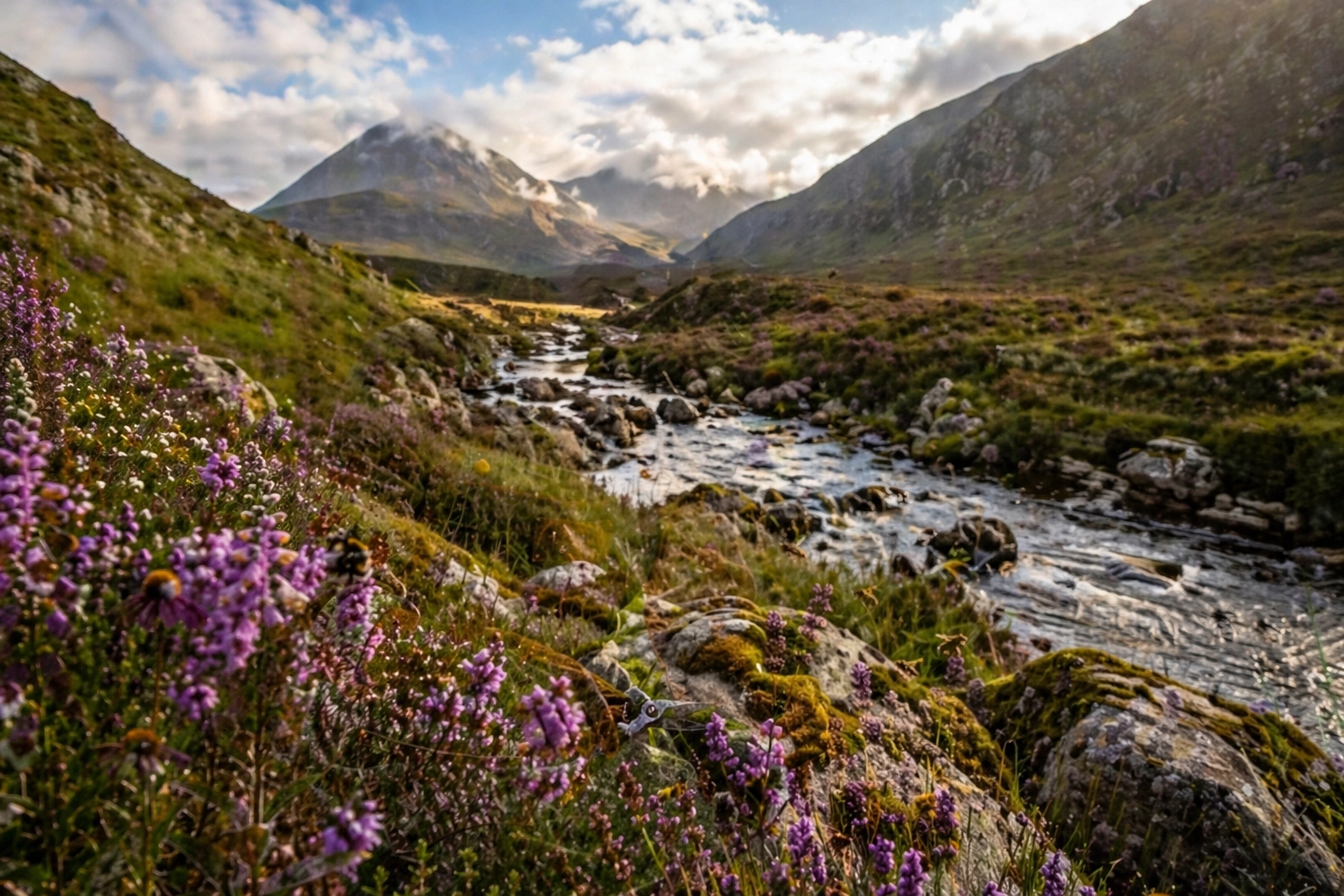
Scotland has a way of humbling you before you’ve even unpacked your bag. I arrived at The Burn, a 200-acre estate in Glen Esk in Aberdeenshire, with a notebook, a mild caffeine dependency, and the vague confidence of someone who works with the dead for a living. The name of the place comes from the small stream that meanders through its grounds. I left with mud in my boots, a head full of anthropological theory, and a strange grief for the bumblebees.
The training was STAR1, an introductory course in anthropology field skills. I’d expected the usual mixture of intellectual stimulation and bodily discomfort that seems to accompany any worthwhile learning. What I hadn’t anticipated was the walkway.
On the way down to the stream, a path wound around the bushes and through the estate grounds. It is, as it happens, a remarkable path. It was built by Napoleonic prisoners of war in the early nineteenth century, much of it cut through solid rock along the North Esk. Centuries of feet have worn it smooth. It was along here, in that corridor between the ordered world above and the water below, that the bees appeared. Mixed species, most of them; honeybees and others going about their business in the usual urgent way. But the bumblebees were different. They were on the ground, or nearly on it. And they were incomplete. Each one was missing its abdomen, its back end simply gone, the rest of the body still present and, in some cases, still faintly moving. Dead, or dying. The distinction, at that point, felt unkind to press.
Something had taken that part of them. Pesticide, parasite, or predator; I still don’t know which. Each possibility carries its own kind of weight. One suggests the slow violence of the agricultural landscape creeping even here. Another, an intimacy of invasion that is hard to think about for long. The third, at least, belongs to the ordinary brutality of things eating other things. I found myself turning the question over as I walked, without arriving anywhere useful, which felt, on reflection, like quite an appropriate introduction to fieldwork.
“They were easy to miss. That, I suppose, is the point.”
Nobody else seemed to notice, or if they did they said nothing. Perhaps that’s what fieldwork trains you for, the narrowing of focus, the bracketing out of the peripheral. But I kept finding them, one after another along the same stretch of path, like something was happening in that particular place that nobody had thought to name yet. Prisoners once cut this path through rock by hand. Queens Victoria and Albert walked it in 1861. Now I was walking it, looking at the dying bees, and wondering what else had been quietly happening here that nobody recorded.
There is something almost indecent about the death of a bumblebee. They are such visibly alive creatures; loud, round, apparently oblivious to the aerodynamic improbability of their own flight. To see one still is to feel a small wrongness in the world. To see one still and diminished, missing a part of itself, is something closer to a question.
As a funeral director, I have made my peace with the proximity of living and dying, or at least, I have accepted the terms of that proximity. What the burn taught me is that the same acceptance is demanded of fieldwork, and perhaps of anthropology itself. You arrive in a landscape expecting to read it on your own terms, and instead it reads you. The stream doesn’t pause for your course schedule. The bees don’t time their dying for a convenient moment in the curriculum.
The STAR1 training was excellent; methodical, grounding, full of the kind of practical knowledge that textbooks gesture at but never quite deliver. I came away with skills I’ll use. But I also came away thinking about thresholds, the thin line between noticing and not noticing, between a dead bumblebee being a fact and it being a feeling. Field anthropology lives in that gap. So, in its own way, does end of life care.
The burn ran on regardless. Cold, clear, and entirely unimpressed with any of us.